
GHRP-2 vs GHRP-6: Structure and Batch Verification
A neutral, research-use-only comparison of GHRP-2 and GHRP-6: shared ghrelin-receptor target, where their sequences diverge, and how a lab verifies each batch.
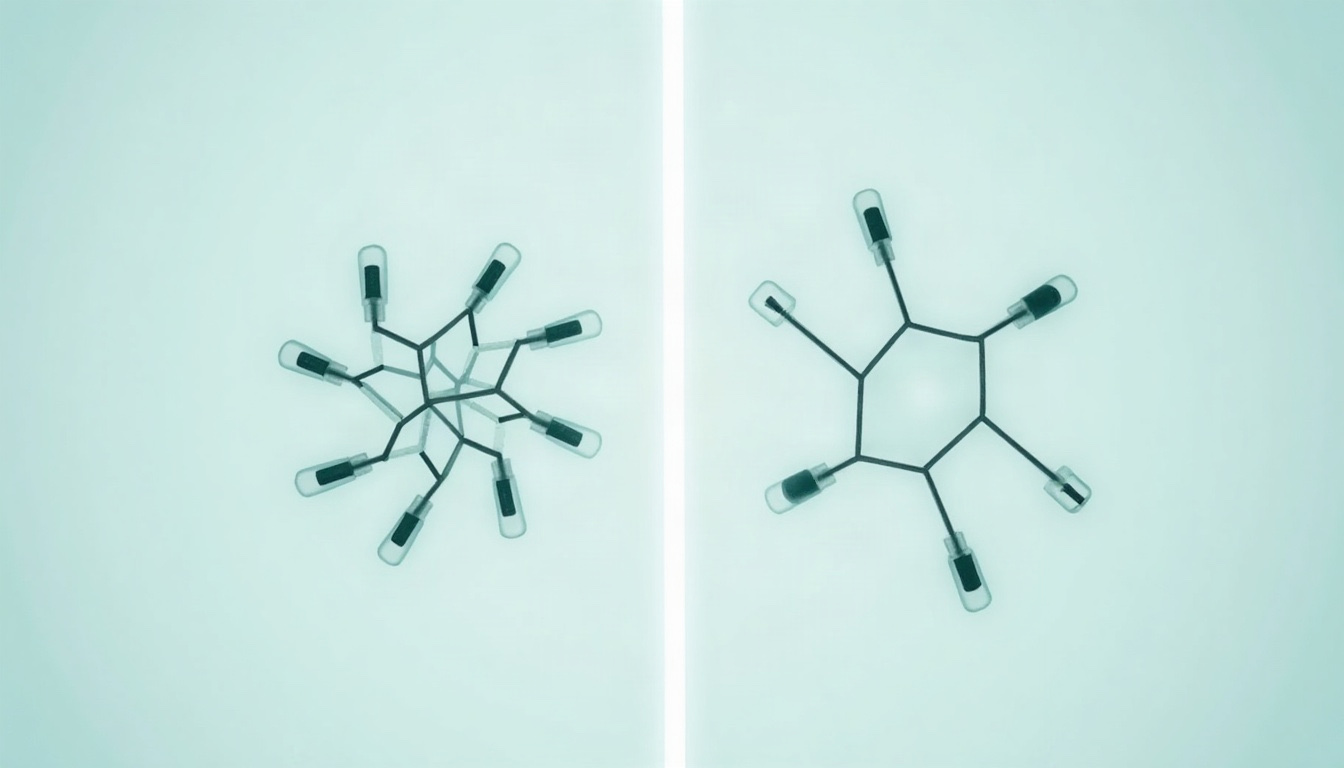
GHRP-2 and GHRP-6 at a glance
GHRP-2 and GHRP-6 are two synthetic growth-hormone-releasing peptides that are frequently studied side by side in the laboratory. Both are short synthetic hexapeptides that act as growth hormone secretagogues at the same target, the GHS-R1a ghrelin receptor. The core structural difference is at the N-terminal end of the chain: GHRP-2 and GHRP-6 share an identical C-terminal motif but carry different amino acid residues at the first two positions, which is what gives each compound its own identity on an analytical readout.
GHRP-2 also carries the International Nonproprietary Name pralmorelin and appears under that name in much of the published literature. GHRP-6 is referenced only by its research designation. Because the two sequences overlap so closely, they are easy to confuse by name alone, which is exactly why identity and purity testing of each received batch matters more than the label on the vial. This article is written strictly for laboratory research audiences and describes documented chemistry and published research context only; it does not describe any human or animal use.
Shared sequence, divergent N-terminus
Both peptides are hexapeptides, meaning each is built from six amino acid residues with a C-terminal amide. They share the same C-terminal stretch, which is the segment most associated with binding at the ghrelin receptor. The divergence sits at the first two residues.
GHRP-2 (pralmorelin) is commonly written as D-Ala-D-2-Nal-Ala-Trp-D-Phe-Lys-NH2. The feature that most distinguishes it structurally is the D-2-naphthylalanine residue near the N-terminus, a bulky aromatic group not present in GHRP-6. GHRP-6 is commonly written as His-D-Trp-Ala-Trp-D-Phe-Lys-NH2, opening instead with a histidine and a D-tryptophan.
These substitutions change the molecular mass and the chromatographic and spectral fingerprint of each compound. That is useful in the laboratory because it means a correctly run identity test can separate the two even though their names and overall architecture are similar.
- Shared architecture: both are synthetic hexapeptides with a C-terminal amide and a conserved C-terminal motif.
- Divergence point: the first two N-terminal residues differ.
- GHRP-2 signature residue: D-2-naphthylalanine (a bulky aromatic group).
- GHRP-6 signature residues: an N-terminal histidine followed by D-tryptophan.
- Practical consequence: different molecular mass and different analytical fingerprint, so the two can be distinguished by testing.
The common target: the GHS-R1a ghrelin receptor
Both GHRP-2 and GHRP-6 are classified as growth hormone secretagogues, and both are documented to act at the growth hormone secretagogue receptor type 1a, also written GHS-R1a. This is the same G-protein-coupled receptor that the endogenous peptide ghrelin binds. In the research literature, compounds of this class are grouped together precisely because they converge on this receptor rather than on the separate growth-hormone-releasing-hormone receptor.
Describing a shared molecular target is a neutral structural statement about receptor pharmacology studied in published models. It is not a claim about any effect in a person or animal, and nothing in this comparison should be read that way. The point for a research buyer is narrower: two compounds that engage the same receptor family but differ at the N-terminus are an obvious pairing for comparative work, and comparative work depends on knowing with confidence which of the two is actually in each vial.
Research context in the published literature
GHRP-2 and GHRP-6 have both appeared in the scientific literature since the development of the GHRP class, and structure-function reviews of ghrelin and growth-hormone-releasing peptides discuss them together. GHRP-2, under the name pralmorelin, has been described in the literature in the context of growth hormone stimulation and diagnostic research settings, where secretagogues have been studied as tools for probing the growth hormone axis.
These are statements about what has been examined in published research, written in the third person about the literature. They are not endorsements, not efficacy claims, and not guidance of any kind. Where a specific study, date or statistic is not something we can verify precisely, we leave it out rather than estimate. For a laboratory, the relevant takeaway is that both compounds have an established research footprint, which makes accurate identification and documentation of a received batch part of good practice rather than an optional extra.
How a laboratory tells the two compounds apart
Because GHRP-2 and GHRP-6 share most of their structure, a receiving laboratory does not rely on the name on the vial. It relies on analytical identity and purity testing. Two routine techniques do most of the work. High performance liquid chromatography, usually reversed-phase HPLC, separates components by how they interact with the column and reports a purity figure from the relative peak areas. Mass spectrometry confirms identity by measuring molecular mass, which differs between the two peptides because of their different N-terminal residues.
Read together, these results answer the two questions that matter at intake. First, is this the compound the label claims, GHRP-2 or GHRP-6, rather than the other one or an unrelated peptide. Second, how pure is it, and what is the nature of any minor impurities. A mislabelled or low-purity input silently undermines every downstream measurement, so this step is where confidence in a comparison is actually established.
- Reversed-phase HPLC: separates components and reports a purity percentage from peak areas.
- Mass spectrometry: confirms identity via molecular mass, which differs between GHRP-2 and GHRP-6.
- Identity check: confirms which of the two near-identical sequences is present.
- Purity check: quantifies the main peak and flags minor impurities.
Australian sourcing and Novagen batch verification
Pepology's position on this pairing is deliberately narrow: rather than arguing which compound is preferable, the focus is on helping an Australian laboratory confirm exactly what it has received. Stock is sourced for the Australian research market and each batch is paired with third-party analytical documentation produced by Novagen, so purity and identity are verifiable against a certificate rather than taken on trust.
That verification record is the practical core of any honest GHRP-2 versus GHRP-6 comparison. A batch certificate links a specific lot to its HPLC purity result and its identity confirmation, which lets a researcher reconcile the physical vial in hand with a documented analytical result. Where a public batch register is available, that same lot can be cross-checked independently rather than relying on a single supplied document.
Regulatory and anti-doping status in Australia
In Australia, growth-hormone-releasing peptides including pralmorelin (GHRP-2) and GHRP-6 are captured by the Poisons Standard and are not registered on the ARTG as medicines for general supply. They are not approved consumer products. Anyone handling these compounds should confirm the current scheduling directly against the live compilation of the Poisons Standard, because scheduling entries are periodically reviewed and the authoritative text is the current instrument rather than any summary.
In the context of sport, growth hormone secretagogues, including the GHRP class, sit on the WADA Prohibited List under class S2 (peptide hormones, growth factors, related substances and mimetics). This is relevant to anyone whose research intersects with athletes or sporting bodies. These are compliance facts about status, not usage instructions, and they reinforce why these items are offered strictly as laboratory research compounds and nothing else. For the current list, always check the official WADA source for the relevant year.
Frequently asked questions
What is the difference between GHRP-2 and GHRP-6?
Both are synthetic growth-hormone-releasing hexapeptides that act at the GHS-R1a ghrelin receptor and share an identical C-terminal motif. They differ at the first two N-terminal residues: GHRP-2 (pralmorelin) carries a distinctive D-2-naphthylalanine residue, while GHRP-6 opens with histidine and D-tryptophan. That difference changes their molecular mass and analytical fingerprint, so a laboratory can tell them apart by testing.
Are GHRP-2 and GHRP-6 legal to buy in Australia?
Growth-hormone-releasing peptides including pralmorelin (GHRP-2) and GHRP-6 are captured by the Poisons Standard and are not registered on the ARTG as medicines for general supply. They are supplied strictly as laboratory research compounds, not as consumer or therapeutic products. Confirm the current scheduling against the live compilation of the Poisons Standard before handling them.
Is GHRP-6 banned by WADA?
Yes. Growth hormone secretagogues, including GHRP-6 and GHRP-2, are listed on the WADA Prohibited List under class S2 (peptide hormones, growth factors, related substances and mimetics). This applies in and out of competition for athletes bound by the Code. Always check the official WADA list for the relevant year for the authoritative entry.
What receptor do GHRP-2 and GHRP-6 act on?
Both are documented to act at the growth hormone secretagogue receptor type 1a (GHS-R1a), the same receptor that endogenous ghrelin binds. They are grouped in the same research class because they converge on this target, which is why they are often compared side by side in the literature.
Why does the molecular difference between GHRP-2 and GHRP-6 matter for research?
The two sequences are similar enough to be confused by name, but they are distinct compounds with different masses and spectral fingerprints. Confirming which one is actually in a vial, via identity and purity testing, protects the integrity of any comparative study. A mislabelled or impure input can quietly compromise downstream measurements.
Does Pepology provide batch documentation for GHRP-2 and GHRP-6?
Stock is sourced for the Australian research market and each batch is paired with third-party Novagen analytical documentation, so purity and identity can be verified against a certificate rather than taken on trust. Where a public batch register is available, the same lot can be cross-checked independently.
This article is general information for research buyers. All Pepology products are supplied strictly for laboratory research use only and are not for human or animal use. Every batch is independently tested by Novagen Laboratories and verifiable on a public register.