
Lyophilised vs Liquid Peptides Explained
A laboratory-science comparison of freeze-dried peptide powder and reconstituted peptide solution, covering stability, degradation pathways and storage principles.
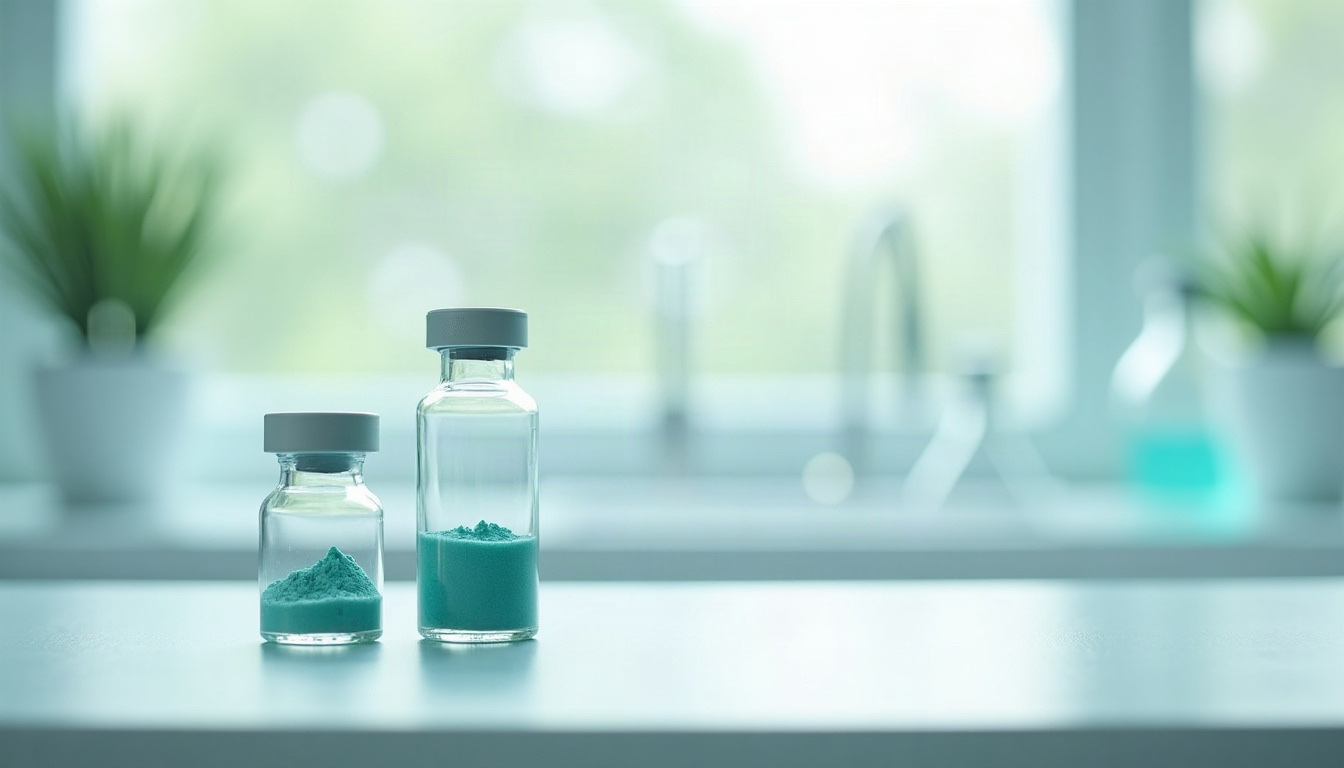
Lyophilised vs liquid peptides: the core difference
The core difference is water. A lyophilised peptide is a freeze-dried solid with almost all water removed, while a liquid or reconstituted peptide is that same compound dissolved in a solvent. In laboratory terms, the dry powder is the long-term storage form and the solution is the short-lived working form. Removing water from the solid state slows most of the chemical reactions that change a peptide over time, which is why research-grade peptides are almost always supplied as lyophilised powder rather than pre-mixed liquid.
Once a peptide is dissolved, it generally becomes far less stable. Water is both a reactant and a medium: it participates directly in some breakdown reactions and it carries dissolved oxygen and dissolved salts into contact with the molecule. For this reason the laboratory handling question is rarely powder or liquid as a matter of preference. The powder is the shelf form, and a solution is prepared only when a measurement or experiment requires it. Everything below is general laboratory stability science and is written for research-use-only context, not as any preparation or use instruction for people or animals.
What lyophilisation actually is
Lyophilisation, also called freeze-drying, is a dehydration process used across the pharmaceutical and research-chemical sectors. The peptide solution is frozen, then placed under high vacuum so that the frozen water sublimes, meaning it passes directly from ice to vapour without melting into liquid first. A secondary drying stage then removes residual bound moisture. The result is a dry, often fluffy or caked solid that is chemically more stable than the original solution.
The appeal of freeze-drying is that it preserves a fragile molecule by taking away the thing that degrades it, rather than by heating it. Heat-based drying would risk denaturing or breaking the peptide, whereas sublimation under cold vacuum is comparatively gentle. The finished powder is typically low in moisture, which is central to its longer stability.
- Freezing: the aqueous peptide solution is frozen solid.
- Primary drying: vacuum sublimation removes the bulk ice.
- Secondary drying: residual bound water is drawn off.
- Result: a dry solid intended for long-term storage.
Why research peptides are supplied as powder
Peptides are supplied lyophilised because the dry solid resists the main routes of chemical change far better than a solution does. With water largely absent, hydrolysis is suppressed, oxidation is slowed because there is less medium to carry dissolved oxygen, and microbial growth cannot take hold in a dry powder the way it can in an unpreserved liquid. The powder form is therefore the practical choice for shipping and shelf storage, especially where material may sit for extended periods before any laboratory work begins.
It is important not to overstate this. Freeze-drying does not make a peptide permanently inert. Published work on solid-state peptides shows that some covalent changes, such as disulfide-related rearrangements, can still occur slowly even in the dry state, and the powder remains sensitive to humidity and light. Many peptides are hygroscopic, meaning they readily draw moisture from the surrounding air if a vial is left open. The dry form buys stability; it does not suspend chemistry entirely.
Peptide degradation pathways
Understanding why the powder is more stable means understanding how peptides change over time. Several well-described degradation pathways appear in the peptide chemistry literature, and most of them are accelerated by water, heat or light.
These pathways are the reason storage conditions matter and the reason a solution is treated as a short-lived form in laboratory settings.
- Hydrolysis: water cleaves bonds in the peptide backbone or side chains. It is a primary degradation route for peptides in solution and is strongly suppressed in the dry state.
- Oxidation: residues such as methionine and cysteine are particularly prone to oxidation, a process helped along by dissolved oxygen and light.
- Deamidation: asparagine and glutamine residues can slowly convert, altering the molecule, with the rate influenced by pH and temperature in solution.
- Aggregation: peptide molecules can associate and come out of solution, which is generally more of a concern once a compound is dissolved.
Reconstitution as a laboratory step
Reconstitution simply means dissolving the lyophilised powder back into a solvent to return it to solution. In a research setting this is a general sample-preparation step, described here only in neutral scientific terms and not as any instruction for human or animal preparation. The choice of solvent, its volume and its handling all influence how the resulting solution behaves and how long it remains representative of the starting material.
A commonly referenced laboratory solvent for this purpose is bacteriostatic water, which contains a small amount of a preservative intended to limit microbial growth in the dissolved sample. Because the solution form is the less stable form, reconstituted material is generally treated as a working stock rather than a long-term store, and conditions are controlled to slow the degradation pathways described above.
Storage and stability principles
Storage conditions are where the powder-versus-liquid distinction becomes most practical. As a general principle in peptide chemistry, lower temperatures slow reaction rates, so cold storage is associated with longer stability, and freezing is often used for longer holds of either form. Light and moisture are additional stressors, so dry, dark and cold is the broad rule of thumb discussed in the literature. Vendor figures for shelf life vary and are often not independently verified, so they should be read with caution rather than treated as fixed facts.
The lyophilised powder tolerates these conditions better and for longer than a solution does. A reconstituted solution is far more sensitive to temperature excursions and to repeated warming and cooling, which is part of why it is handled as a short-term working form. The general storage science and the reasons behind cold handling are covered in more depth in the linked guides.
How to store research peptides in Australia Why peptides are associated with refrigeration
Excipients and cryoprotectants
Freeze-dried formulations often include more than the peptide itself. Bulking agents and stabilisers, sometimes called excipients, are added to protect the molecule during the freezing and drying steps and to give the finished cake good physical structure. Sugars and sugar alcohols such as mannitol and trehalose are frequently referenced in lyophilisation formulation work, along with buffering components like histidine, because they help preserve structure as water is removed.
These components are a formulation and manufacturing consideration rather than a handling instruction. For the purposes of comparing powder and solution, the key point is that a well-formulated lyophilised product is engineered to come out of the dryer stable and to go back into solution cleanly when a laboratory requires it.
Purity, identity and why verification matters
Neither the powder form nor the solution form tells you, on its own, what the material actually is or how pure it is. That is a separate analytical question answered by laboratory testing rather than by appearance. A dry cake can look identical whether it is high purity or not, and the degradation pathways above can change a sample without any visible sign.
This is why analytical methods are used to characterise peptides independently of their physical form. High-performance liquid chromatography is one of the standard techniques referenced for assessing peptide purity and separating a target compound from related impurities, and it underpins the certificates of analysis that accompany research-grade material.
Frequently asked questions
What is lyophilisation?
Lyophilisation, or freeze-drying, is a dehydration process where a frozen peptide solution is placed under vacuum so the ice sublimes directly to vapour, leaving a dry solid. It is used because it removes water gently, without the heat that could damage a fragile molecule.
Why are peptides sold as powder?
Peptides are supplied as lyophilised powder because the dry solid resists degradation far better than a solution. Removing water suppresses hydrolysis, slows oxidation and prevents microbial growth, making the powder the practical form for shipping and long-term shelf storage.
Do lyophilised peptides need refrigeration?
As a general stability principle, lower temperatures slow the reactions that change peptides over time, so cold and often frozen storage is associated with longer stability for the dry powder. Light and moisture are additional stressors, so dry, dark and cold is the broad rule discussed in the literature. Specific conditions depend on the individual compound and formulation.
How long do reconstituted peptides last?
A reconstituted solution is generally the less stable form and is treated as a short-lived working stock rather than a long-term store, because dissolving the powder reactivates water-driven degradation pathways. Published and vendor figures vary widely and are often not independently verified, so no fixed number applies to every compound.
What does reconstitution mean?
Reconstitution means dissolving a lyophilised powder back into a solvent to return it to solution. In a research context it is a general sample-preparation step. A commonly referenced laboratory solvent is bacteriostatic water, which contains a preservative intended to limit microbial growth in the dissolved sample.
Are liquid peptides less stable than powder?
Generally yes. Once dissolved, a peptide is exposed to water as both a reactant and a medium that carries dissolved oxygen and salts, which accelerates hydrolysis, oxidation, deamidation and aggregation. This is why the dry powder is the storage form and a solution is prepared only when work requires it.
What are cryoprotectants and excipients in freeze-dried peptides?
These are additional components included in some lyophilised formulations to protect the molecule during freezing and drying and to give the finished cake good physical structure. Sugars and sugar alcohols such as mannitol and trehalose, along with buffers like histidine, are frequently referenced in lyophilisation formulation science.
This article is general information for research buyers. All Pepology products are supplied strictly for laboratory research use only and are not for human or animal use. Every batch is independently tested by Novagen Laboratories and verifiable on a public register.